

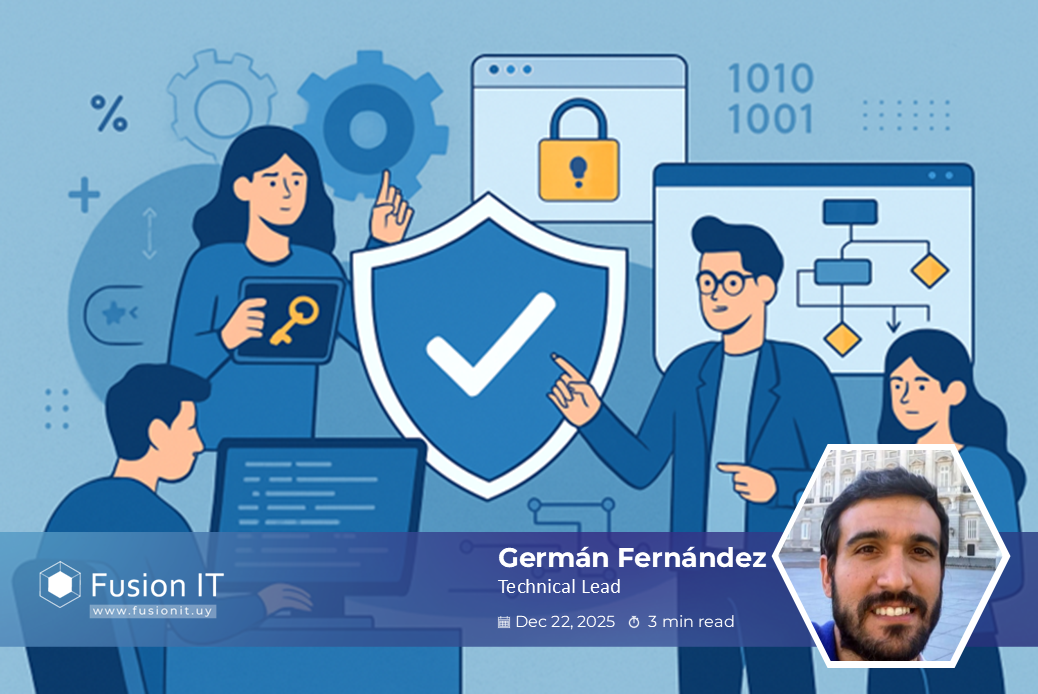
Security isn’t something you patch on after the fact; it’s something you design from the start.
How do you build software that stays secure long after launch?
At Fusion IT, we embed security into every layer of the development lifecycle; from design to deployment. This article explores how we approach secure development through four key dimensions: threat modeling, DevSecOps automation, architecture for failure, and security as culture.
Start with Threat Modeling, Not Code
Security doesn’t start with code; it starts with questions.
Before a single function is written, we run threat-modeling sessions to map data flows, trust boundaries, and potential attack surfaces. Imagine designing an authentication service where tokens flow between web, mobile, and API layers. That exercise might reveal that local token revocation is too fragile, prompting the design of a centralized identity service with short-lived tokens instead.
This early analysis shapes how systems are built; which services see which data, where access controls live, and how layers communicate securely. It’s not paranoia but design discipline. Anticipating threats upfront saves far more effort than reacting to them later.
DevSecOps in action: Automating what matters
Once the design is set, automation becomes the guardrail. Security and delivery move together.
Our CI/CD pipelines include built-in security gates that:
- Scan dependencies, detect secrets, and analyze static code.
- Validate infrastructure-as-code templates before provisioning.
- Halt automatically if vulnerabilities or misconfigurations are found.
Meanwhile, secure-coding practices; inspired by OWASP and Microsoft SDL; become everyday habits: input validation, centralized encryption logic, consistent error handling, and dependency hygiene.
Every change flow through version control and peer review, with full audit trails. If a rollback is ever needed, we know what changed, who changed it, and why.
Picture this: a new pull request introduces a query parameter but forgets sanitization. The static analyzer flags it, blocking the merge until it’s fixed. No manual policing; just safety by default.
Architecture for Failure, Not Perfection
Design assuming failure, not success.
We build systems on defense-in-depth and Zero Trust principles, with strong environment separation (DEV → STG → PROD). Suppose a configuration is misapplied in staging; the isolation ensures it never reaches Production. The system fails safely, triggers an alert, and gets corrected before it impacts users.
Security testing is built into our process. Automated scanners run continuously, complemented by manual exploratory testing and periodic penetration tests with tools like Burp Suite and OWASP related such as OWASP Dependency Check.
Developers are encouraged to think like attackers; to understand how their own code might break and how to make it stronger.
This mindset keeps security active, not reactive.
It’s a matter of Culture over Compliance
The story doesn’t end at deployment; it evolves. Standards like ISO 27001 provide structure, but culture gives meaning.
In Production, monitoring and telemetry detect anomalies, authentication irregularities, configuration drift, or suspicious network activity, and trigger rapid response workflows.
In Testing, we ensure realism without risk by using synthetic or anonymized datasets. IDs remain valid for logic tests, but personal or sensitive data is replaced or masked to avoid data exposure.
Ultimately, technology is only as strong as the people behind it. At Fusion IT, everyone shares ownership of security outcomes. Security isn’t just a responsibility; it’s a source of pride.
Final Thoughts
Designing secure software isn’t about ticking boxes; it’s about creating with purpose. It must be woven into the DNA of how systems are imagined, built, and maintained. It’s both an engineering practice and an act of craftsmanship, one that balances precision, discipline, and creativity.
From early threat modeling, where potential risks are discussed before the first sprint begins, to automated pipelines that enforce security controls without slowing delivery, to architectures that assume failure and recover gracefully where every phase carries the same intent: to earn and preserve trust.
Technology will always evolve, frameworks will change, and new vulnerabilities will appear. What endures is the mindset, the belief that security isn’t a “deliverable”; it’s a principle of design.
At Fusion IT, we don’t build systems we “hope” will stay safe. We build systems designed to stay safe, engineered to anticipate failure, and ready to adapt. Because trust isn’t a feature you add later; it’s the foundation you build from the beginning… the quiet assurance behind every line of code and every deployment we deliver.